



INTRODUCTION
Nestled in Delhi’s Purana Qila, Sher Mandal stands as an epitome of architectural monuments of the 16th century. Suggested to be built by Sher Shah, the ruler of the Suri dynasty who defeated the second Mughal Emperor Humayun in the battle of Kannauj in 1540. Sher Shah ruled for 5 years in Delhi and built many architectural beauties; one of them included Sher Mandal. Although there is no conclusive evidence to firmly attribute its construction to him. There is a similarity between the architects of the Delhi Sultanate and the Mughals, as both of them are inspired by Islamic architecture. Originally Sher Mandal was built by Sher Shah, ruler of the Suri kingdom in Delhi; however, Humayun who repurposed Sher Mandal as a library and astronomical observatory, reflecting his scholarly interests in astrology and books.
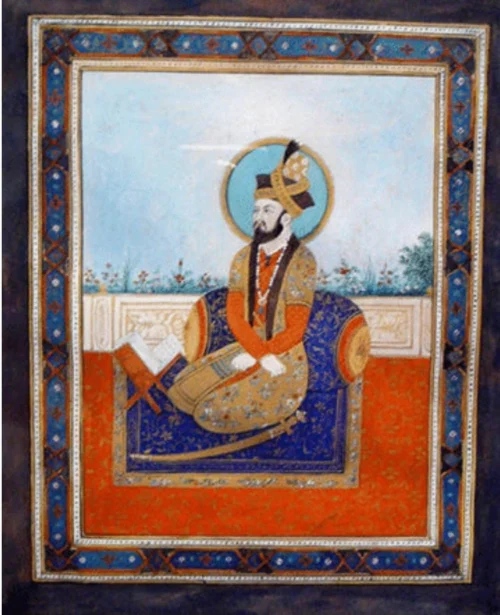
The name Humayu implies fortunate, but he proved to be an unlucky monarch. Along with the empire, he inherited many difficulties. He was taught to read and write in the Turkish, Persian and Arabic languages and was imparted instruction in various subjects, including religion and philosophy, astronomy, fine arts and military science. However, his reign was disturbed by Sher Shah for 5 years when Sher Shah took over Delhi. Sher Shah, during his 5 years, built Sher Mandal, which was later used by Humanyu, but then he died falling from his library, Sher Mandal.
SHER MANDAL
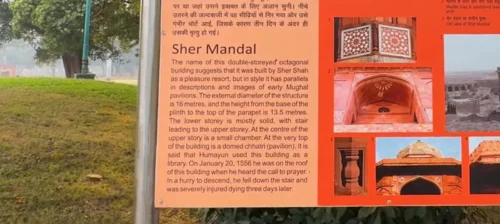
Sher Mandal is a double-storeyed octagonal Mandal built by Sher Shah as a pleasure resort, but in style it has parallels in descriptions and images of early Mughal pavilions. Historically it is debated who actually laid the foundation of Sher Mandal, but Sher Shah is often credited with it.

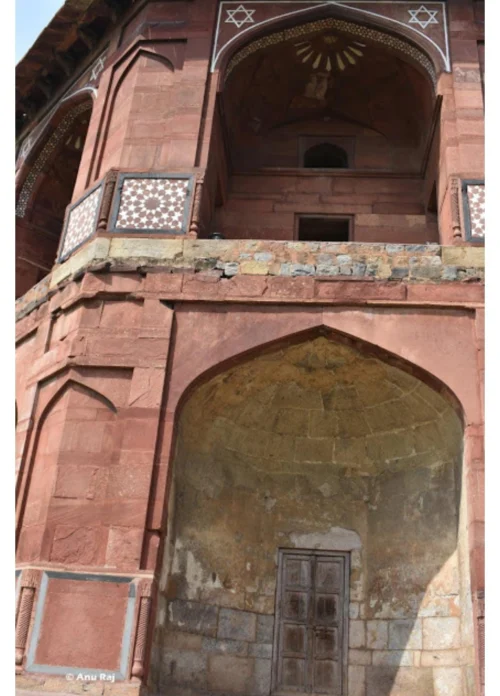
As you can see above, the Mandal is octagonal in shape, which supports both religious and scientific reasons discussed below. Apart from that, the Mandal structure is big, with 16 metres around. The height of the structure is 13.5 metres from the base to the top. There are eight spaces in this part one on each side of the octagon, rectangular or semi-octagonal, alternating between the two. The structure has carved stone corners with a chevron design. (an upside-down V, where the two sides meet at the point).
The house has staircases on the southwest and northwest sides that go up to the storey. The stairs are made of granite. Stairs are steep and narrow, and unlike modern times, they are not even.One has to be very careful while using the stairs. These stairs later became that part of the history which entirely changed the power dynamics and shift of the Mughal Empire.
DETAILING
Openings and Niches
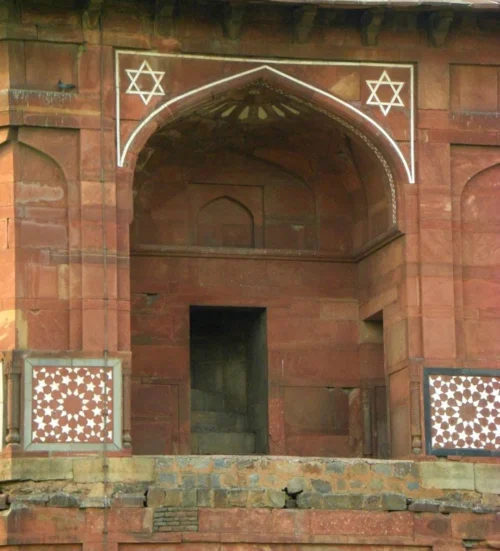
Each side of the octagon features arched openings and shallow niches, carefully proportioned to maintain symmetry. These niches were used for storing books or objects, making it a royal library or for study. The structure is designed with a domed chhatri, supported on tall slender pillars.
Decorative Detailing
Sher Mandal does not have any heavy ornamentation. It is very minimal; major focus is given to geometric proportion and spatial harmony rather than elaborate embellishment. Geometric designs are a prominent characteristic of Islamic art, which was modified to surpass limitations on portraying animals or human subjects, going beyond older designs and thereby introducing new designs in the form of geometry functioning as a universally applicable means of creative representation.
IMPORTANCE OF OCTAGONAL SHAPE
Have you ever noticed Mughal architects are predominantly octagonal in shape? That is because in Islam there is a deep historical concept in which the earth represents the base of the architect and the dome in the monument represents the heaven. So there is a cosmic relation between both the earth and the heaven. An octagon has eight sides; each of these sides is associated with paradise, which symbolises balance, order and perfection.
Apart from the religious perspective, an octagon shape gives an edge, providing better lighting since there was not a concept of light during those days. The shape also helped in cross ventilation, which was very important during that time, keeping in mind the harsh climate of Delhi in summer. Overall the octagonal shape provides structural stability for tall domed pavilions.

A TRAGEDY THIS ARCHITECT HOLDS
Sher Mandal was used by Humayun as a library and to observe the stars (observatory), as he was interested in astronomy. But he was not aware of the fact that the architect which he was using would be the reason for his death. Apart from the jewellery, the Mughals used to wear elaborate gowns called ‘jama‘, which were heavily embroidered and elaborate gowns. Humayun was believed to be a superstitious and religious person. On January 24, 1556, while he was on the roof of the Sher Mandal, he heard the sound of Namaz. In his haste to go downstairs for prayers, his foot got caught in his clothes (gown), Jama. The stairs were very narrow and steep, causing him to fall and sustain serious injuries. He died after three days, which marked the turning point in Mughal history, ending the reign of Humanyu and placing the empire in the hands of young Akbar.
SOURCE: BLOG.LINDSAYWASHERE
CONCLUSION
Sher Mandal today is not widely popular among the masses. People frequently visit Purana Quila; however, they pay less attention to Sher Mandal. Very few people truly recognise the significance of the Mandal. It should be understood not merely as the site of a royal tragedy but as a transitional intellectual pavilion reflecting the evolving architectural and scholarly sensibilities of the mid-sixteenth century. It is one of the beautiful monuments Delhi has, which already has a huge history in itself.
REFERENCE
Emami, Farshid. “Royal Assemblies and Imperial Libraries: Polygonal Pavilions and Their Functions in Mughal and Safavid Architecture.” Journal of the Society of Architectural Historians, 2019, ResearchGate,
www.researchgate.net/publication/335123322_Royal_Assemblies_and_Imperial_Libraries_Polygonal_Pavilions_and_Their_Functions_in_Mughal_and_Safavid_Architecture.
Archaeological Survey of India. Purana Qila: Sher Mandal. Indira Gandhi National Centre for the Arts (IGNCA),
ignca.gov.in/Asi_data/21762.pdf.
Julka, Aman. “Explore Delhi: Old Fort (Purana Qila) – Sher Mandal.” Amanjul Blog, 27 Jan. 2020,
amanjul.wordpress.com/2020/01/27/explore-delhi-old-fort-purana-qila-2-sher-mandal/.